The document is based on a series of studies on industrial estates undertaken in late 1995. Its aim is to provide decision-makers in the public and private sector with general guidelines for the establishment of estates, but key aspects of estate development are also illustrated with examples from different countries.

Development Dialogue Seminars
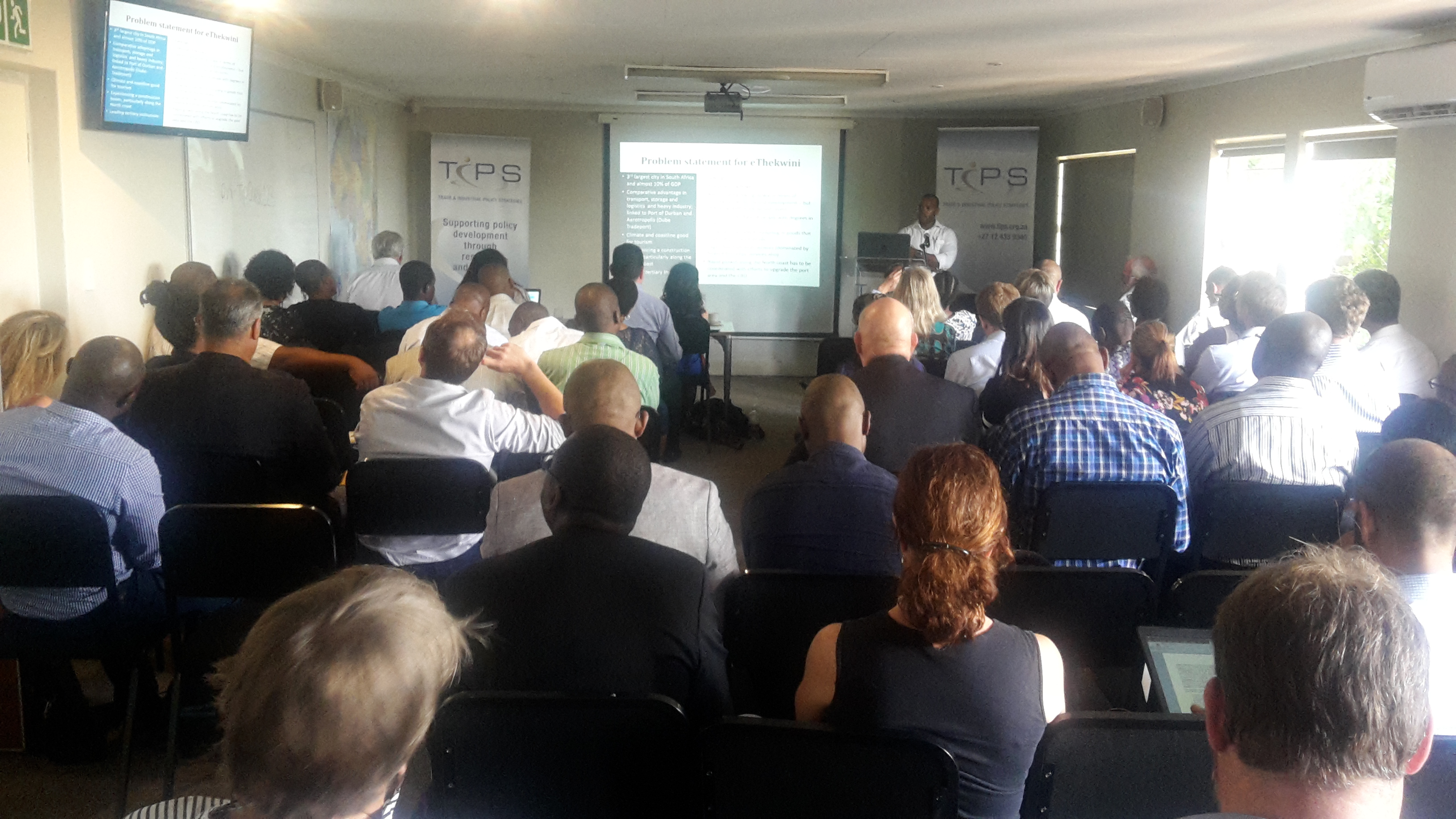
The Development Dialogue Seminar is a seminar series hosted by TIPS. The seminars offer a platform to share views and ideas on specific development issues and alternative policy strategies.
Though the seminar programme has been designed for government officials for whom the themes tackled are of relevance, the seminars fact focuses on a wide range of topical development issues. The themes covered span the informal economy to specific trade negotiation challenges. The seminars also attempts to offer perspectives from other countries in the region and beyond.
Who can attend?
Government officials and others who contribute to policy are targeted by the seminar series but all are welcome, though places are limited.
If you would like to attend please contact Rozale Sewduth at rozale@tips.org.za. Please specify food allergies if any, as a light lunch will be served prior to the seminar.
This article revisits the relationship between the state and industrial development in Africa. The analysis shows the mutuality of states and markets in African industrialization, contrary to the neoliberal strategy. A disciplined activist African state that governs the market is essential for industrial development and recovery. Using empirical evidence from Botswana, we show how Botswana has induced a relatively successful industrialization project, contrary to the general trend of deindustrialization and retraction of state involvement in Africa in the 1980s and 1990s. This case study challenges the neoliberal camp's belief about SAP's efficacy in addressing the crisis in African economies. It…
Our concern in this paper is with firm-specific industrial policy. When R&D subsidies or taxes are differentiated among firms, the question arises as to which firms in an industry should receive such support. We analyze a situation where firms differ in their R&D technologies in two distinct ways: in the costs of performing R&D activities and in the output obtained from such activities. We find that the optimal firm-specific industrial policy is affected differently by the two sources of firm heterogeneity. Furthermore, a change in a firms R&D productivity has an ambiguous effect on the optimal policy towards the firm.
There are three main paradigms that are the basis for the industrial policies throughout the world: institutionalism, Marxism, and free-enterprise. Of the three, two have been widely and intensively implemented and both of them have dismally failed. Institutionalism and Marxism either are, or have been, attempted to the fullest degree in the United States and abroad. Both have left nations struggling to find something better. The answer to this troublesome question is simple. No industrial policy is the best industrial policy. The classical liberals and libertarians have been arguing this since the days of Adam Smith, yet for the most…
COSATU's submission to Parliament regarding the effect of the Department of Trade and Industry's industrial policy on the performance of manufacturing focuses specifically on: an assessment of the content and sequencing of certain supply-side measures, the role of institutions supporting industrial development, present trends within the global economy, and the need for improved enforcement of competition policy and more effective regulation of the industrial environment. In order to deepen the Committee's understanding of the impact of government industrial policy measures on a wide range of sectors, COSATU has facilitated the participation of some of our manufacturing-based affiliates. Further, COSATU recommends…