This report examines the trade and industrial policies currently advocated by the major development agencies. It calls for a shift away from the current emphasis on extreme trade liberalization to one that recognizes the role of targeted government policies in promoting balanced economic growth. For the last decade, the less developed countries (LDCs) have been encouraged by the major development agencies simply to open up their markets to imports and to export whatever products they can produce relatively cheaply in the short-term. Many forms of development assistance, ranging from World Bank structural adjustment loans to International Monetary Fund (IMF) assistance…

Development Dialogue Seminars
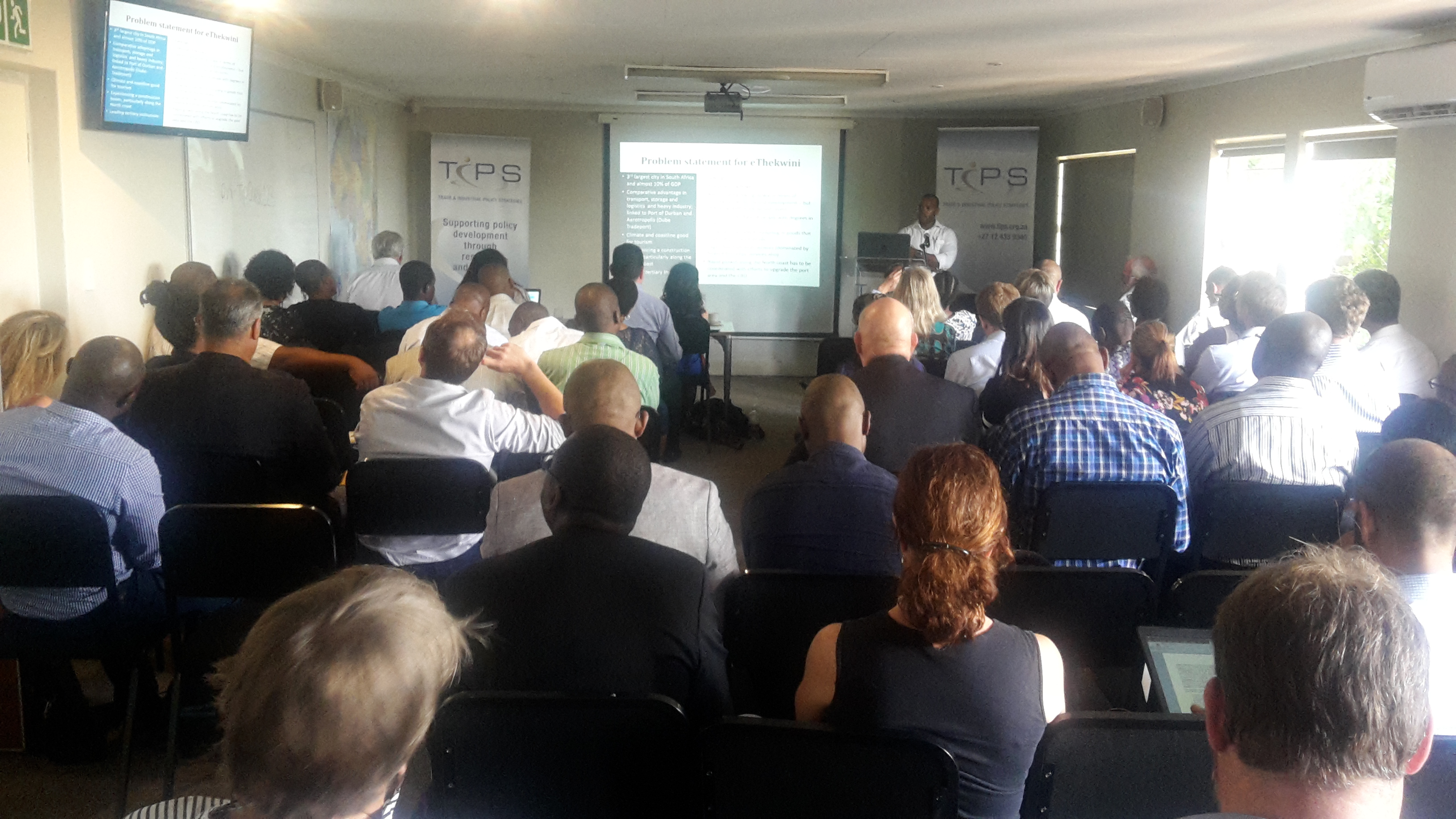
The Development Dialogue Seminar is a seminar series hosted by TIPS. The seminars offer a platform to share views and ideas on specific development issues and alternative policy strategies.
Though the seminar programme has been designed for government officials for whom the themes tackled are of relevance, the seminars fact focuses on a wide range of topical development issues. The themes covered span the informal economy to specific trade negotiation challenges. The seminars also attempts to offer perspectives from other countries in the region and beyond.
Who can attend?
Government officials and others who contribute to policy are targeted by the seminar series but all are welcome, though places are limited.
If you would like to attend please contact Rozale Sewduth at rozale@tips.org.za. Please specify food allergies if any, as a light lunch will be served prior to the seminar.
This background paper for the 1995 Global Forum on Industry focuses on issues to be considered by the countries of sub-Saharan Africa (SSA) in order to implement strategies for 2000 and beyond. In the context of the challenges posed to industrial policies by the potential changes in the international trade environment and domestic economic management strategies, the paper emphasizes supply-side strategies and the attainment of comparative advantage in both domestic and export markets for industrial output. The study concludes that while the lack of meaningful industrialization reflects past failures of economic policy, declining trade is the cause of lower productivity…
We empirically evaluate the aggregate welfare effects and structural adjustment for the Spanish economy that would follow from trade liberalization with the European Economic Community. Recent theory suggests that the classical gains form more liberal trade relations could be amplified substantially if EEC liberalization permits Spanish industries to realize economies of scale. These effects depend upon the extent of trade creation and trade diversion resulting from preferential liberalization, which in turn depend on the existing patterns of Spanish resource allocation, trade, and comparative advantage. The estimated results are derived from disaggregated microeconomic model of the Spanish economy. We find that…
Encouraging the growth of small and medium enterprises (SMEs) is widely seen as being an important plank of industrial policy in developing countries. Concerns that motivate state-backed SME support programmes range from the laudable aims of creating jobs, improving welfare, alleviating poverty, raising incomes, and enhancing technical and entrepreneurial capacities to the often expedient, political considerations of fostering key constituencies in civil society. The decline of the so-called 'golden age of capitalism' set into motion various forms of economic restructuring. In industry this has taken the shape of a move away from Fordist to flexible systems of production, an emphasis…
This paper assesses the coherence of industrial policy, competition policy and trade policy in the European Union (EU). This assessment is undertaken from the perspective of the optimal deployment of economic policies as prescribed by economic analysis,. In doing so, it takes into consideration the legal mandate of and institutional constraints imposed by EU treaties and regulations. The analysis shows that, as a result of the limited policy tools available to the Union, trade and competition policies have to serve the pursuance of several competing goals. This multiplicity of objectives leads to sub-optimal interventions. Policy inconsistencies also arise between trade/competition…
- Industrial Policy and Semiconductors: Missing the Target
- Recent Industrial Policies in Developing Countries and Economies in Transition: Trends and Impact
- Industrial Policy Reforms: The Changing Role of Governments and Private Sector Development
- Pitfalls in the Theory of International Trade Policy: Concertina Reforms of Tariffs and Subsidies to High-Technology Industries