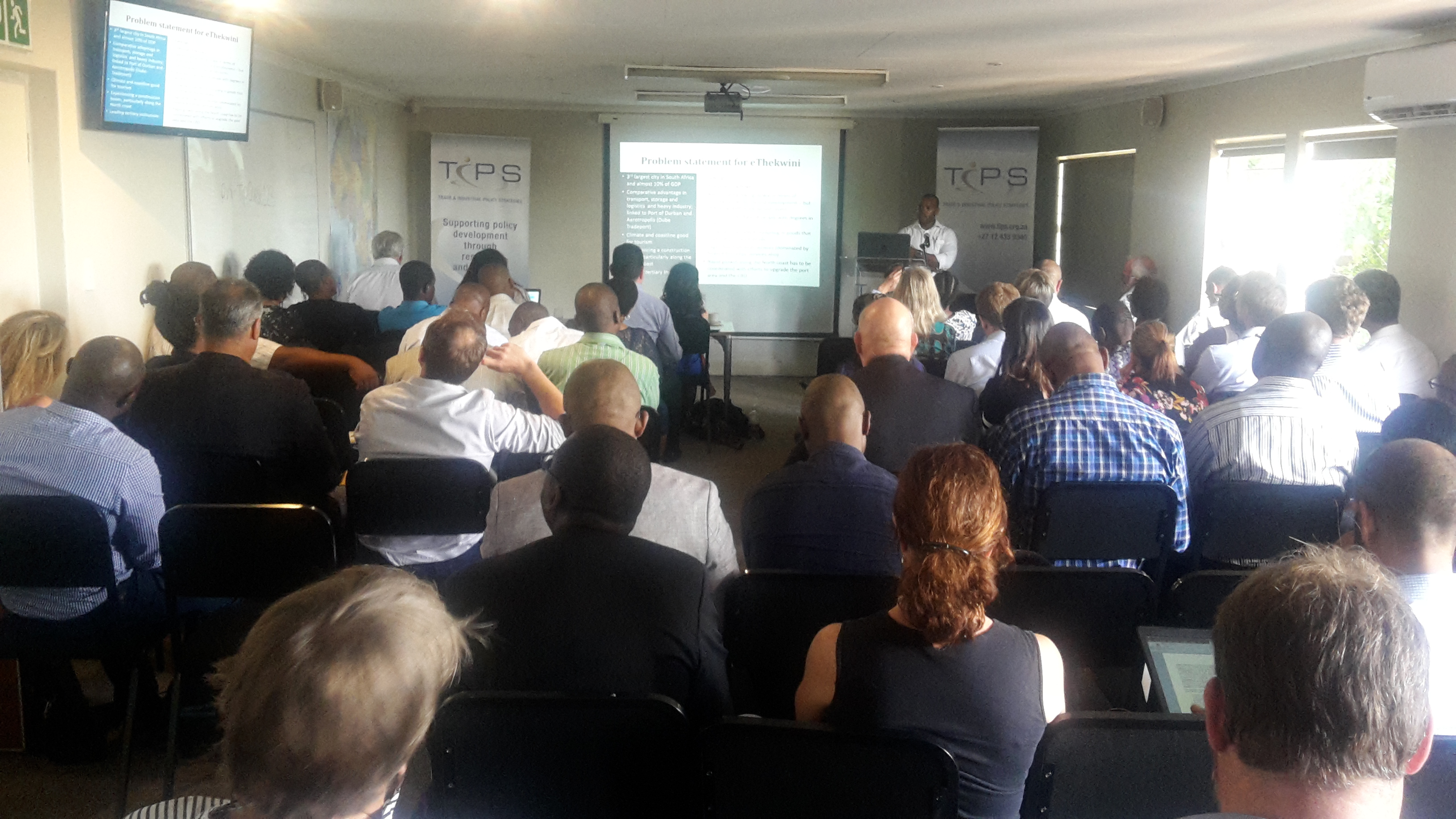
ABOUT THE SPEAKER Jamie Simpson is an economic and management consultant with 25 years experience related to port planning, infrastructure investment and city-region economic development. He has extensive experience as a Project Director/Manager leading major projects and working with governments and senior executives on strategic planning, investment plans and economic transformation – in Europe, Asia, Africa and North America. He has provided advisory support on a range of port market studies and due diligence for the leading port operators (HPH, DPW, PSA, APMT, ICTSI, China Merchants) and financial institutions (HSBC, BoC, B&B Infrastructure, JPMorgan, Standard and Chartered) as part of…

Development Dialogue Seminars
The Development Dialogue Seminar is a seminar series hosted by TIPS. The seminars offer a platform to share views and ideas on specific development issues and alternative policy strategies.
Though the seminar programme has been designed for government officials for whom the themes tackled are of relevance, the seminars fact focuses on a wide range of topical development issues. The themes covered span the informal economy to specific trade negotiation challenges. The seminars also attempts to offer perspectives from other countries in the region and beyond.
Who can attend?
Government officials and others who contribute to policy are targeted by the seminar series but all are welcome, though places are limited.
If you would like to attend please contact Rozale Sewduth at rozale@tips.org.za. Please specify food allergies if any, as a light lunch will be served prior to the seminar.
During the upcoming APORDE 2014 a series of public evening seminars will be held : 1. Taking Inequality Analysis beyond the Gini Co-efficient Speaker: Gabriel Palma Date: Tuesday 2 September 2014 Time: From 19h00 (refreshments from 18:30) Venue: IDC conference centre, Co-host: IDC RSVP: lorrainep@idc.co.za 2. African Development in Historical Perspective Speaker: Bill Freund Date: Wednesday 3 September 2014 Time: From 18h30 Venue: Wits University, Graduate School of Humanities seminar room (South West Engineering Building, East Campus next to the Great Hall) Co-host: PARI RSVP: darshanab@pari.org.za 3. Inaugural Alice Amsden Memorial Lecture: How Economies Grow: Alice Amsden and the Real…
The presentation will explore the viability of shale gas in South Africa from an economic lens. By focusing on issues such as geology, decline rates and breakeven costs of wells and exploring the relationship between gas prices and cash-flows, the presentation will seek to answer the core question of whether a shale revolution would occur in South Africa. In doing so, it will explore questions around the longevity of a shale revolution, the price at which shale gas is commercially viable, and the economic lessons from the US shale revolution. Finally, it will look at the outstanding research questions pertaining…
Alice Amsden Memorial Lecture Speaker – Professor Stephanie Seguino How Economies Grow: Alice Amsden and the Real World Economics of Late Industrialisation 4 September 2014 - 18:30 for 19:00 (light dinner served) ABOUT THE SPEAKER Stephanie Seguino is Professor of Economics at the University of Vermont, USA; Professorial Research Associate at the School of Oriental and African Studies (SOAS), University of London; and Research Scholar at the Political Economy Research Institute at the University of Massachusetts/Amherst. Prior to obtaining a Ph.D. from American University, she served as economist in Haiti for several years in the pre- and post-Baby Doc era.…
TIPS recently completed a study investigating the impact of the controversial Eskom electricity supply agreement with Aluminium mining conglomerate BHP Billiton using a cost-benefit analysis (CBA) methodology to assess the costs and benefits to society of cancelling the special pricing agreement (SPA) that Eskom has with BHP Billiton. The CBA considered the following scenarios (i) Continuing with the current electricity arrangement (ii) Removing the electricity subsidy permitted to the BHP aluminium smelters and allowing the electricity price they pay to adjust to megaflex rates, and (iii) Comparing scenarios (i) and (ii). The focus of this Development Dialogue will be to…
- Protectionism or consumer concern?
- Technical regulations - protectionism or consumer concern
- Moving from failed 'anti-developmental' microcredit to a 'developmental' local financial system in South Africa: exploring the key institutions, problems and prospects
- Why is inequality so unequal across the world?