The aim of this workshop is to build research and policy capabilities in the South African government to better understand the dynamics of value chains and in so doing, to contribute to employment growth and productivity enhancement through upgrading. The workshop will address the following issues: What are value chains? What differentiates them from simple input/output economic linkages? How are value chains governed, and by whom, and how does this affect the capacity to upgrade? What role do standards play in value chains? Given intense competition, how do value chains upgrade and in what directions? How does an understanding of…

Development Dialogue Seminars
The Development Dialogue Seminar is a seminar series hosted by TIPS. The seminars offer a platform to share views and ideas on specific development issues and alternative policy strategies.
Though the seminar programme has been designed for government officials for whom the themes tackled are of relevance, the seminars fact focuses on a wide range of topical development issues. The themes covered span the informal economy to specific trade negotiation challenges. The seminars also attempts to offer perspectives from other countries in the region and beyond.
Who can attend?
Government officials and others who contribute to policy are targeted by the seminar series but all are welcome, though places are limited.
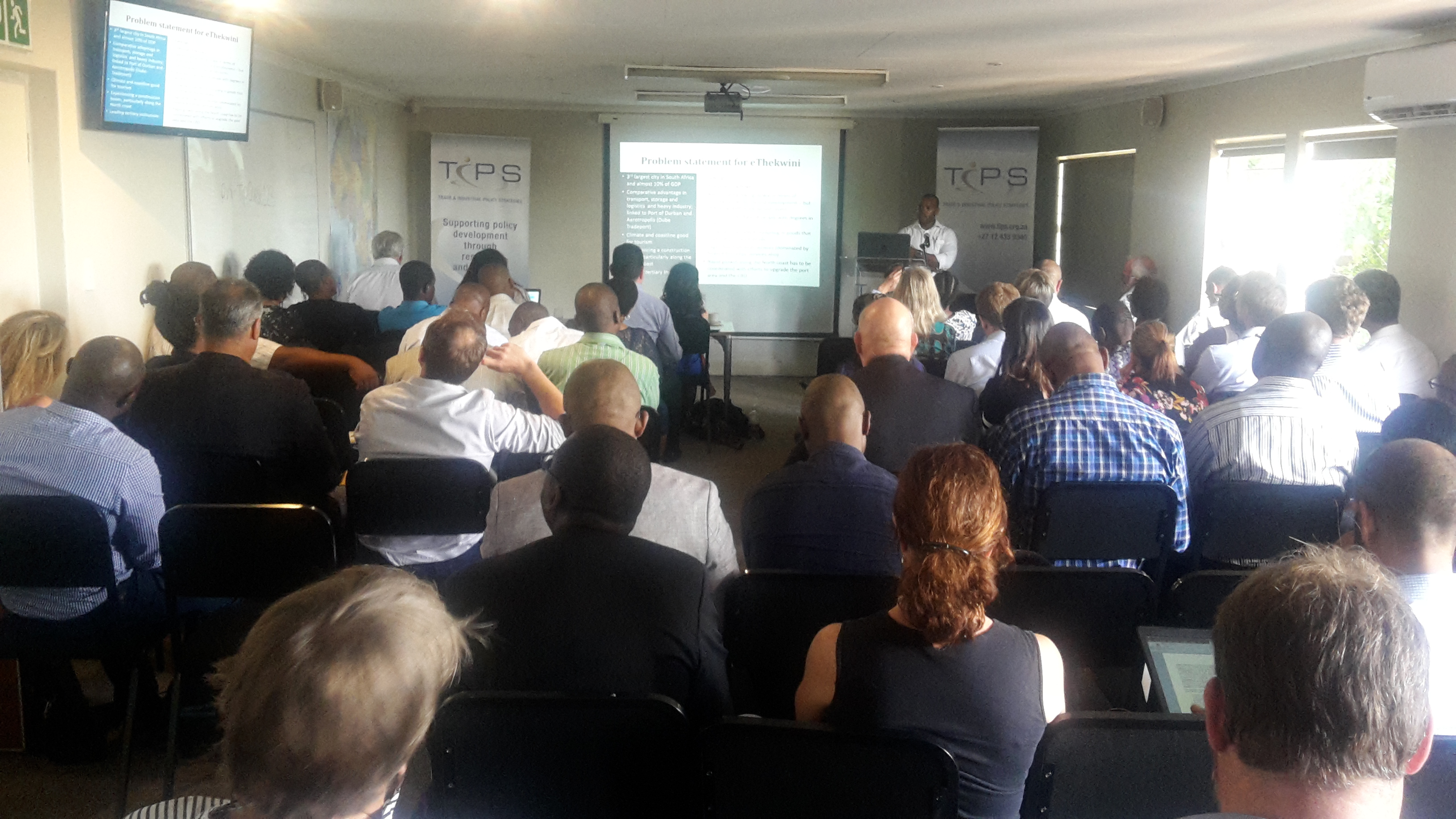
If you would like to attend please contact Rozale Sewduth at rozale@tips.org.za. Please specify food allergies if any, as a light lunch will be served prior to the seminar.
South Africa is in a unique position to benefit from the transition to a greener development path, particularly owing to the country's abundance in renewable resources (solar and wind predominantly). Accordingly, the country has demonstrated an increasing commitment to sustainable development, notably in the field of renewable energy. Recognising the importance of effective economic regulation for the sustainable growth and development of South Africa, the Economic Development Department (EDD) commissioned the Centre for Competition, Regulation and Economic Development (CCRED) at the University of Johannesburg (UJ) to undertake a Regulatory Entities' Capacity Building Project. The project involves a review of the…
The adoption of the Millennium Declaration in 2000 by all Member States of the United Nations was a defining moment for global development cooperation. In recognition of the need to translate this commitment into action, the Millennium Development Goals (MDGs) were adopted. The MDGs have defined a common framework of priorities for the development community. In 2010, the UN General Assembly convened to review progress on the MDG targets and agreed on a concrete action plan to accelerate progress towards their full achievement by 2015. It also called on the UN System to lead the international discussion on post-2015 development…
There is growing concern that measures already in place or potentially adopted by developed countries to combat climate change could be trade distortionary, introduce new forms of 'green protectionism' and/or be discriminatory. Such policy and regulatory measures may range from emissions trading schemes (e.g. the EU's deferred airlines tax) to border tax adjustments that price carbon, subsidies, new public and/or private standards (including carbon labelling schemes), taxes on maritime transportation and, among other non-tariff barriers to trade, could entail the introduction of specific legislation. Discussion bocussed on the following three questions from an industry/sector perspective: • Using specific examples, is…
The African Growth and Opportunity Act (AGOA) is a unilateral trade policy concession governing United States and sub-Saharan Africa trade and investment relations. AGOA enhances US market access for 40 Sub-Saharan African (SSA) countries, including South Africa. Signed into law by the US Congress in May 2000, AGOA has been renewed several times and is now set to expire in September 2015. With the review of AGOA currently underway, this seminar, will bring together the region's foremost trade think tanks (i.e. South African Institute of International Affairs (SAIIA), TIPS and trade law centre (Tralac); industry leaders and key government officials,…