Numerous discussions are being held throughout the country on the alignment of the global Sustainable Development Goals (SDGs) with the National Development Plan (NDP), and how this alignment could be reinforced through the domestication of the SDGs and associated indicators. To foster further multi-stakeholder discussions, the South Africa-European Union (SA-EU) Sustainability Transition Dialogue is supporting the organisation of five multi-stakeholder workshops to be hosted in different locations in the first half of 2017. The SA-EU Sustainability Transition Dialogue is organised in partnership with the The SA-EU Dialogue Facility, the Departments of Environmental Affairs, Planning, Monitoring and Evaluation, and Science and…

Development Dialogue Seminars
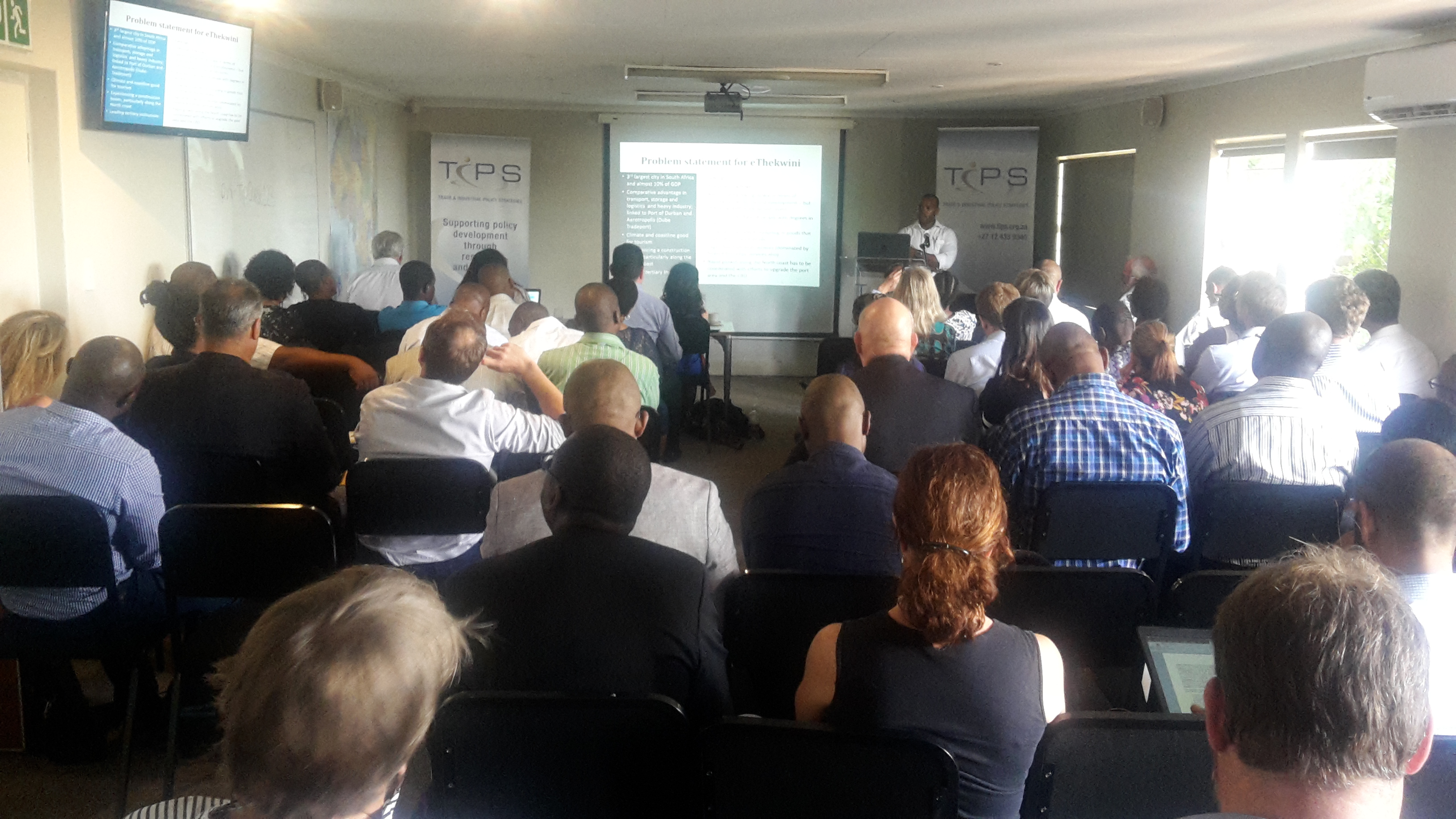
The Development Dialogue Seminar is a seminar series hosted by TIPS. The seminars offer a platform to share views and ideas on specific development issues and alternative policy strategies.
Though the seminar programme has been designed for government officials for whom the themes tackled are of relevance, the seminars fact focuses on a wide range of topical development issues. The themes covered span the informal economy to specific trade negotiation challenges. The seminars also attempts to offer perspectives from other countries in the region and beyond.
Who can attend?
Government officials and others who contribute to policy are targeted by the seminar series but all are welcome, though places are limited.
If you would like to attend please contact Rozale Sewduth at rozale@tips.org.za. Please specify food allergies if any, as a light lunch will be served prior to the seminar.
Presentation and Panel Discussion Baba-Tamana Gqubule (TIPS) and Xhanti Payi (Nascence Advisory & Research): Presentation on Outcomes of the latest quarterly Manufacturing Circle Investment Tracker Christopher Wood (TIPS) and Kelello Mashiane (TIPS): Presentation on FDI Data Moleboheng Ntene (Reserve Bank): Presentation on Reserve Bank data Discussant from the dti Background The quarterly Manufacturing Circle Investment Tracker (MCIT) is an initiative of the Manufacturing Circle. It serves to track firm-level investment trends in the South African manufacturing sector. The data on the findings from the third quarter 2016 manufacturing investment trends will be presented. The FDI Data for…
Presentation and Panel Discussion: Faizel Ismail – TIPS and UCT: AGOA - A Game of Chicken Malose Letsoalo – Department of Trade and IndustrY Christopher Wood – TIPS: Making the Best of AGOA through Export Promotion Policies Tinashe Kapuya - Agricultural Business Chamber: An Agriculture Industry Perspective Background The importance of exporting to the US for any developing country cannot be downplayed. Exports to the largest economy in the world along with various support measures has been of cruciall importance to countries such as Japan and South Korea during their industrialisation, more recently for China. The Africa Growth and Opportunities…
TIPS Development Dialogue on behalf of Partnership for Action on Green Economy DESIGNING POLICY FRAMEWORKS FOR A CLIMATE-COMPATIBLE INDUSTRIAL DEVELOPMENT TRANSITION IN SOUTH AFRICA The South African Government is progressively introducing the policy changes aimed at supporting the transition to a sustainable development pathway. These processes aim to manage a balancing act and a highly contested and fluid operating environment. This reinforces the need for robust and evidence-based planning and policymaking. Furthermore, the multi-layered and multi-faceted nature of the policymaking exercise, fraught with unknowns, uncertainties, incomplete information and external variables calls for an incremental, iterative and flexible approach. This session…
BUILDING A VALUE CHAIN FOR THE AUTOMOTIVE INDUSTRY IN AFRICA The Nigerian Market for automobiles is substantial and can readily sustain an automobile industry. In 2012, the country imported about $4 billion worth of automobiles of which about two thirds were pre-owned. Estimated annualdemand for vehicles is over half a million made up of 100,000 new and 400,000 used. As at 2012, the population of the middle class was 38 million and growing, assuring a sustained market for the automotive industry. Opportunities exist for South African automotive Original Equipment Manufacturers (OEMs) to participate in this market and achieve economies of…