About the Presenter: Mmatlou Kalaba a research fellow at TIPS, specialising in trade research. He also carries out TIPS' capacity-building initiatives in the Southern African region, providing training courses on applied analytical and methodological tools. He currently holds a position in the Department of Agricultural Economics at the University of Pretoria. Some of the projects at university of Pretoria include The Joint Agribusiness Department of Agriculture Forum for Africa (JADAFA) under the auspices of Department of Agriculture, Forestry and Fisheries (DAFF) and the Agriculture Business Chamber (ABC) as well as the Bureau for Food and Agricultural Policy (BFAP). Current and…

Development Dialogue Seminars
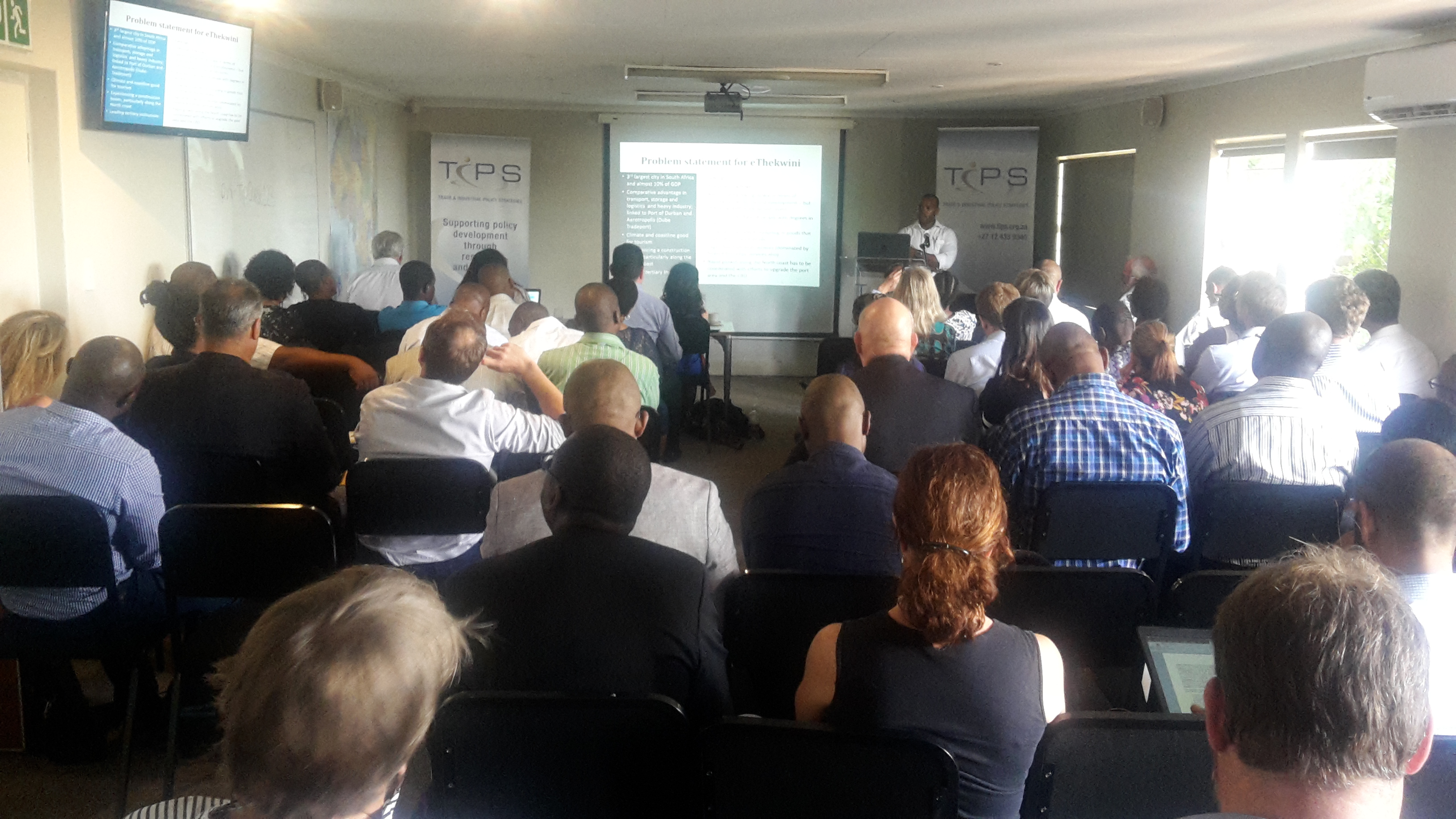
The Development Dialogue Seminar is a seminar series hosted by TIPS. The seminars offer a platform to share views and ideas on specific development issues and alternative policy strategies.
Though the seminar programme has been designed for government officials for whom the themes tackled are of relevance, the seminars fact focuses on a wide range of topical development issues. The themes covered span the informal economy to specific trade negotiation challenges. The seminars also attempts to offer perspectives from other countries in the region and beyond.
Who can attend?
Government officials and others who contribute to policy are targeted by the seminar series but all are welcome, though places are limited.
If you would like to attend please contact Rozale Sewduth at rozale@tips.org.za. Please specify food allergies if any, as a light lunch will be served prior to the seminar.
Trade and Industrial Policy and Strategies (TIPS) and the World Bank cordially invite you to a conference on Improving Competitiveness for Job Creation: Technology, Access to Finance and Industrial Policy, to be held on October 27, 2011 in the Vulindlela Auditorium, Development Bank of Southern Africa. Competitiveness and Job Creation Employment has been identified by various actors as the top development challenge for South Africa, not least because of its implication for income inequality and social unrest. A less prominent – but closely interrelated – economic challenge is that of competitiveness. Growing employment requires growing the economy, which in turn,…
South Africa's economic dominance in Africa and in the southern African region is an accepted fact but its role in the continent has long been contested. South Africa's member ship of the G20 brought with it expectations from some quarters that it would represent Africa within that grouping. The recent admission of South Africa into the BRIC(S) came with many discussions and debates on South Africa's role as a 'gateway' into Africa. But what does this actually mean? Three possibilities have been mooted: “First, multinational companies could use South Africa as a hub for regional headquarters, utilising our superior services…
Competition policy is playing an increasingly significant role in the trade and investment environment in South Africa. According to a 2010 IMF report, there is a high degree of product market restrictiveness in South Africa that is partly exacerbated by anti-competitive behaviour in the markets. This is regarded as being highly trade restrictive. Also, the recent Wal-Mart/Massmart case brought under closer scrutiny the link between investment, competition and trade policy. It highlighted the potential use of competition policy as a vehicle for industrial policy and other domestic economic objectives. Can governments use competition policy to stimulate the growth and development…
In 2005, India introduced the world's first employment guarantee, creating new meaning for the concept of a right to work. This is achieved through the National Rural Employment Guarantee Scheme, established through an act of parliament (NREGA), which gives every rural household the right to demand 100 days of employment (manual labour) per year at a minimum wage. With over 55 million participants, NREGA has become one of the largest poverty programmes in history. Since 2006, it has provided over two billion person-days of work – 48% of which have gone to women. It also includes real innovation in the…
- Foreign Direct Investment Links between South Africa & China
- Does What You Export Matter? In Search of Empirical Guidance of Industrial Policies
- How South Africa Can Boost Support to Small Businesses: Lessons from Brazil & India
- A Re-Examination of SADC Industrial Development Policies and Lessons for SACU