For COSATU, industrial policy is not confined to promoting exports. Such a policy will have limited success. In this paper, it is stated that COSATU reject GEAR and free market purity as being inappropriate to address the socio-economic and political ills of South Africa. Market forces on their own will not build efficient and dynamic industries and they will not maximise the national social and economic interests.

Development Dialogue Seminars
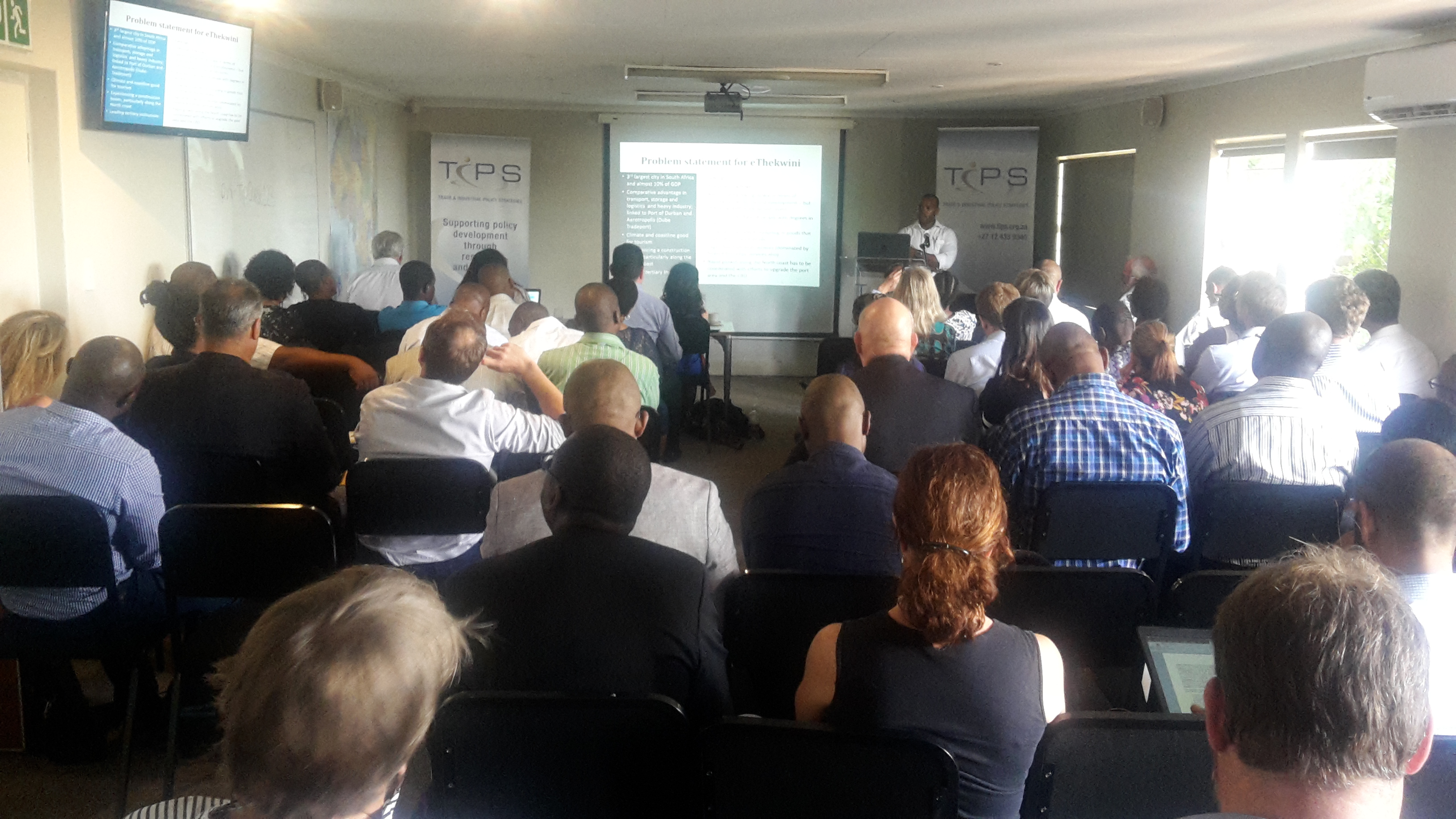
The Development Dialogue Seminar is a seminar series hosted by TIPS. The seminars offer a platform to share views and ideas on specific development issues and alternative policy strategies.
Though the seminar programme has been designed for government officials for whom the themes tackled are of relevance, the seminars fact focuses on a wide range of topical development issues. The themes covered span the informal economy to specific trade negotiation challenges. The seminars also attempts to offer perspectives from other countries in the region and beyond.
Who can attend?
Government officials and others who contribute to policy are targeted by the seminar series but all are welcome, though places are limited.
If you would like to attend please contact Rozale Sewduth at rozale@tips.org.za. Please specify food allergies if any, as a light lunch will be served prior to the seminar.
Technology has long been held to contribute to economic growth through productivity improvement, but early studies of information technology (IT) investments and economic growth found no significant relationship. Indeed, despite large IT investments, national productivity growth in the United States declined in the 1970s and 1980s, leading some to call the situation a productivity paradox. The most persuasive theoretical explanation for the paradox is that IT investments generally have been too small a percentage of the inputs to the economy to have measurable effect. By the mid-nineties, however, IT investments had grown to 4-5% of GDP in the U.S. and…
This paper examines the issue of whether harmonising taxes across the traded and non-traded sectors is desirable. Preferential treatment for the traded sector might be justified if either the output response of subsidies is higher in the traded sector, or if the jobs generated in the traded sector are associated with higher productivity than those in the non-traded sector. The concept of industrial development agencies acting as discriminating monopolists in setting the grant level in different projects underlies this view of the role for industrial policy. This paper uses a simple two sector small open economy model to analyse the…
With the exception of a few countries, the post-independence development of Sub-Saharan Africa has been disappointing. In most countries, the growth of national income has barely kept pace with population growth. In others, GDP and per capita income growth rates have been negative. A combination of high population and urban growth rates before industrialisation have resulted in massive underemployment and unemployment in the urban areas. The origins of these problems lie in the unseating of nationalist and pragmatic governments by imperialism, implementation without adaptation of inappropriate institutions copied from competing ideological camps, adoption of anti-growth economic policies which turned the…
While the South African industrial sector has recently begun to recover from a long period of stagnation, it has failed to create employment. This is ascribed to the restructuring process in this sector and 'over-staffed' firms. While there are lessons to be learned regarding local economic development (LED) from the Latin American and East Asian newly industrialising countries, it is misleading to explain the success of these countries simply in terms of export-orientation. Instead, a mix of both inward- and outward-looking paths of industrialisation was used. The present paper attempts to assess the potential for industrial development as an LED…
- Industrial Policy and East Asia. The Miracle the Crisis and the Future
- Industrial Transformation in Sub-Saharan Africa and its Impact on the Environment
- Industrial Reform to Enhance Industrial Competitiveness: Implications and Strategies for SME Development
- Industrial Policy after the East Asian crisis