Today's economic map of the world is dominated by what are called clusters: geographically concentrated critical masses of unusual competitive success in particular fields. Clusters are not unique, however; they are highly typical. Therein lies a paradox: the enduring competitive advantages in a global economy lie increasingly in local elements - knowledge, relationships, motivation - that distant rivals cannot match. Untangling the paradox of location in a global economy reveals a number of 'key' insights about how companies continually create competitive advantage. What happens inside companies is important, but clusters reveal that the immediate business environment outside companies plays a…

Development Dialogue Seminars
The Development Dialogue Seminar is a seminar series hosted by TIPS. The seminars offer a platform to share views and ideas on specific development issues and alternative policy strategies.
Though the seminar programme has been designed for government officials for whom the themes tackled are of relevance, the seminars fact focuses on a wide range of topical development issues. The themes covered span the informal economy to specific trade negotiation challenges. The seminars also attempts to offer perspectives from other countries in the region and beyond.
Who can attend?
Government officials and others who contribute to policy are targeted by the seminar series but all are welcome, though places are limited.
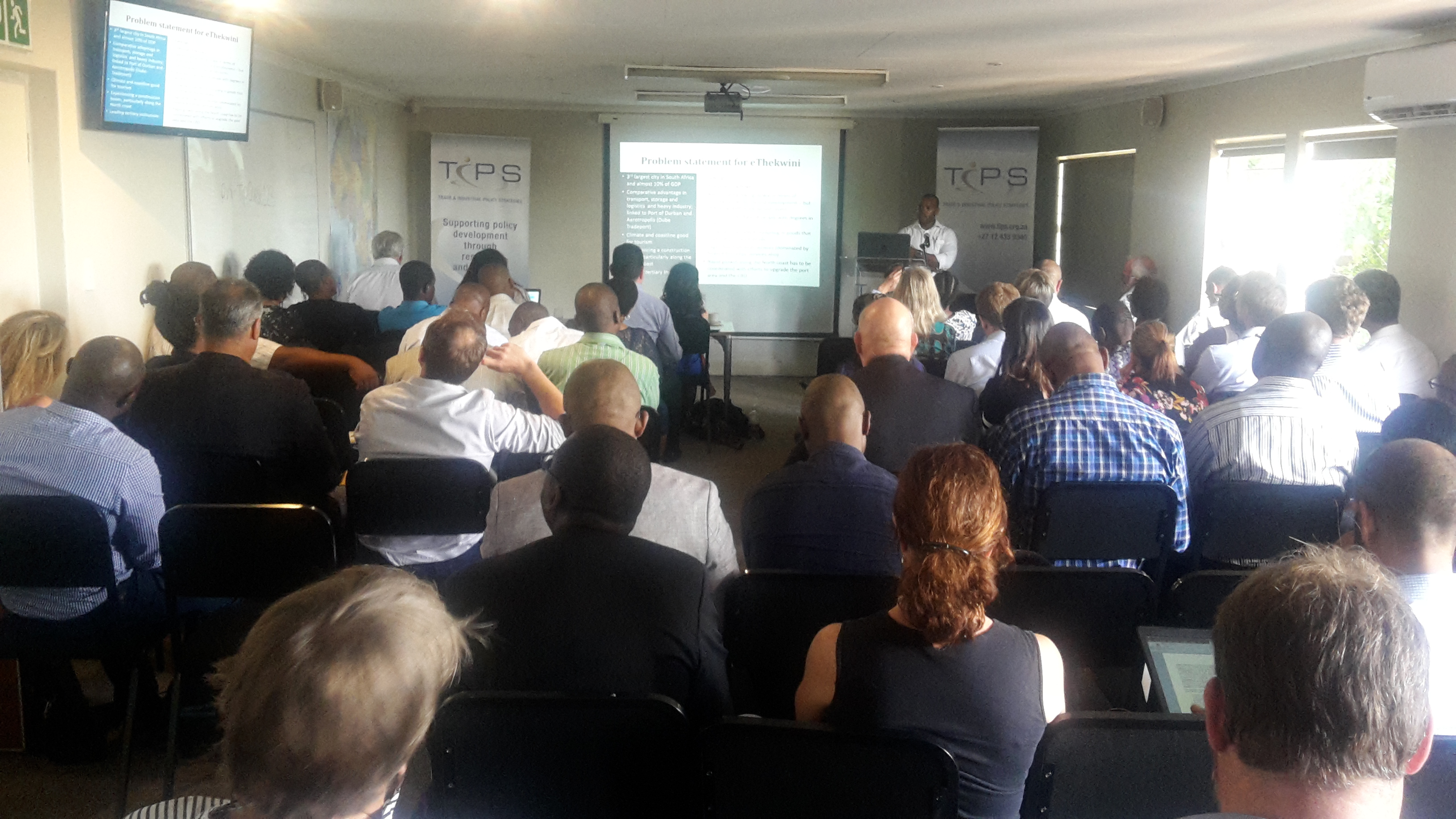
If you would like to attend please contact Rozale Sewduth at rozale@tips.org.za. Please specify food allergies if any, as a light lunch will be served prior to the seminar.
The manufacturing sector has traditionally been the primary focus of both the trade and industrial policy literature and the national departments of trade and industry which practiced the policy for economic development. The reason lies in the ability to trade in manufactured products. Services, by contrast, are often non-tradeable. This paper begins by looking at the aggregate contribution of service industries to the South African economy. This effort concentrates on the contribution to output, growth, capital formation, employment, trade and foreign investment. The second section takes the reader one level down, analysing the nature of service production in South Africa.…
That the growth performance of South African manufacturing industry has deteriorated markedly since the mid- 1970s, and that a major improvement in the performance of this sector is essential for sustained recovery of the economy as a whole, is generally acknowledged. The question of the causes of the deterioration in the performance of manufacturing industry in South Africa, and the requirements for a substantial improvement, however, is much more debatable. The recently published report on of the Industrial Strategy Project (1995) (written by four academics - Avril Joffe, David Kaplan, Raphael Kaplinsky and David Lewis), represents a major attempt to…
The paper attempts to document the various kinds of industrial and technology policy that have commonly be put in practice and then to provide indicators for what might be the best practice approaches to industrial policy for the continuous restructuring that industry needs to go through in this ever changing world.
This article explores the contradictions between the industrial policies of the EU and EU national states and the Single Market program of elimination of NTBs (non-tariff barriers). The scope of NTBs connected to European industrial policy is divided into two spheres: the first are barriers on the level of Member States and the second are barriers on the EU level. On the national level, after the 1992 programme the EU Member States continued to adopt many technical national regulations. On the EU level, measures such as new standards, environment and anti-dumping rules as well as Community expenditures in the different…