Competition Law governs the nature and extent of competitive interaction among firms in all industries. It prohibits certain types of interaction and provides for a rule of reason approach to the assessment of the impact of other types of behaviour on competition. Economic principles therefore underpin this legislation. A sound understanding of the economic concepts and principles that form the foundation of Competition Law is therefore important.

Development Dialogue Seminars
The Development Dialogue Seminar is a seminar series hosted by TIPS. The seminars offer a platform to share views and ideas on specific development issues and alternative policy strategies.
Though the seminar programme has been designed for government officials for whom the themes tackled are of relevance, the seminars fact focuses on a wide range of topical development issues. The themes covered span the informal economy to specific trade negotiation challenges. The seminars also attempts to offer perspectives from other countries in the region and beyond.
Who can attend?
Government officials and others who contribute to policy are targeted by the seminar series but all are welcome, though places are limited.
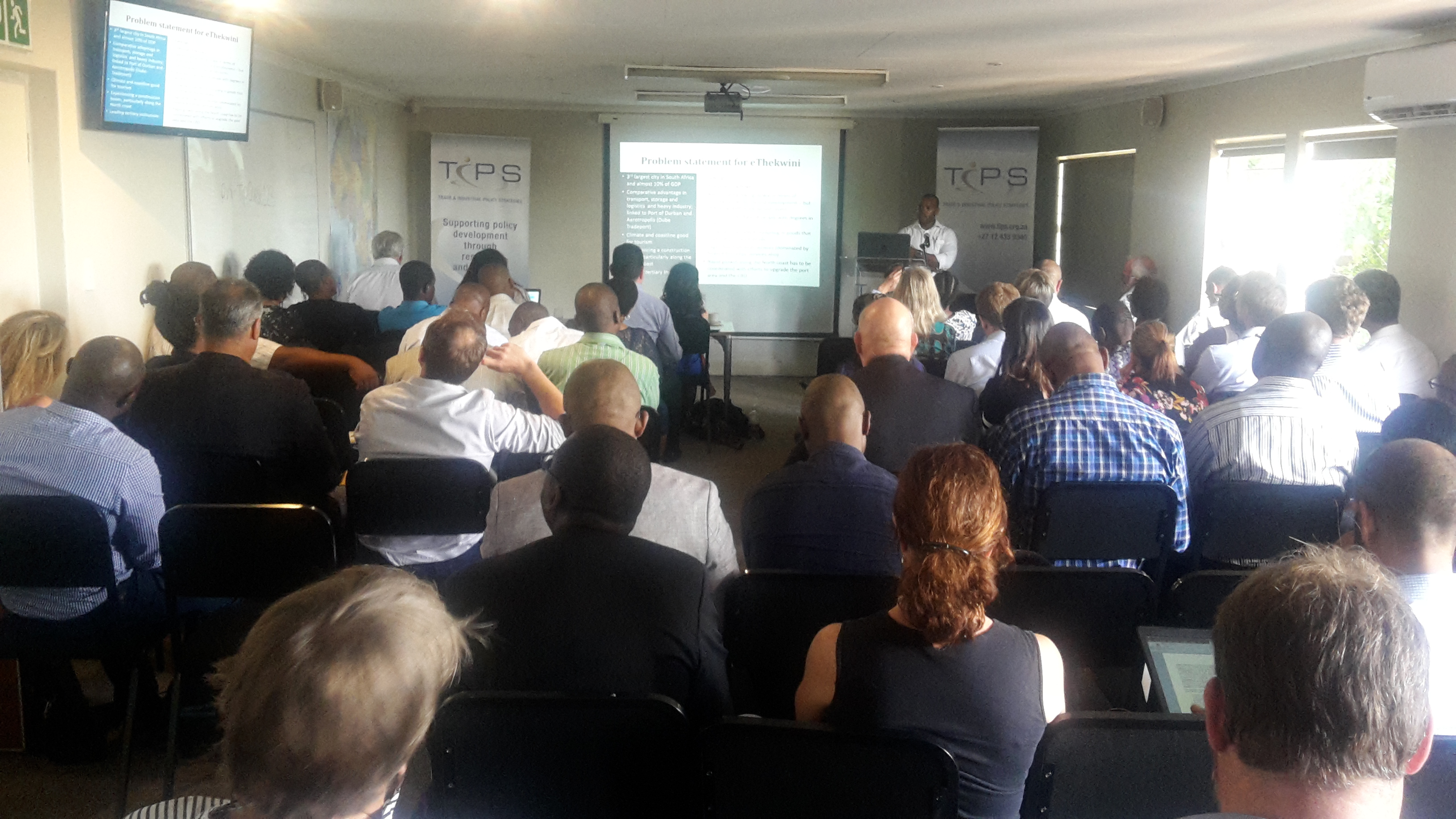
If you would like to attend please contact Rozale Sewduth at rozale@tips.org.za. Please specify food allergies if any, as a light lunch will be served prior to the seminar.
Jean-Jacques Laffont, Director of Institut De Economie Industrielle, Toulouse, and Professor of Economics at University of Toulouse and University of Southern California, Los Angeles, gave a lecture on the Political Economy of Competition and Regulation of Network Industries.
The aim of this seminar was to develop a rigorous economic framework to evaluate the SMME sector in South Africa. There is a rich tradition of SMME work in SA and our aim was not to simply reproduce another SMME report. Instead, to date the synergies between the mainstream economy and the SMME sector have been rather weak and the aim of the project was to simply contextualise the SMME sector in the larger economic debate in the country.
The trade policy training workshop was a follow-up of a TIPS-hosted summer school by Alan L Winters, held during November 1999, that focussed on Trade Policy Tools. One of the aims of the Winters course was to expose researchers to various applied techniques to stimulate research in this area with a view to preparing an ongoing trade policy review of South Africa under the auspices of TIPS.
The Department of Trade & Industry (DTI) is tasked with ensuring that the broad objectives of the RDP and GEAR, in terms of industrial restructuring, export and investment facilitation, as well as job creation and redistribution, are met. The Department has thus put in place a set of programmes and policies aimed at achieving the three central objectives of the RDP and GEAR: Growth; Employment; and Redistribution. Many of the programmes and policies designed by the DTI represent a major departure from the policy framework used by the previous government. The previous government was primarily concerned with ensuring that South…